emma pyle

ed tech + innovation

Archives (page 2 of 3)

Free Inquiry – 6

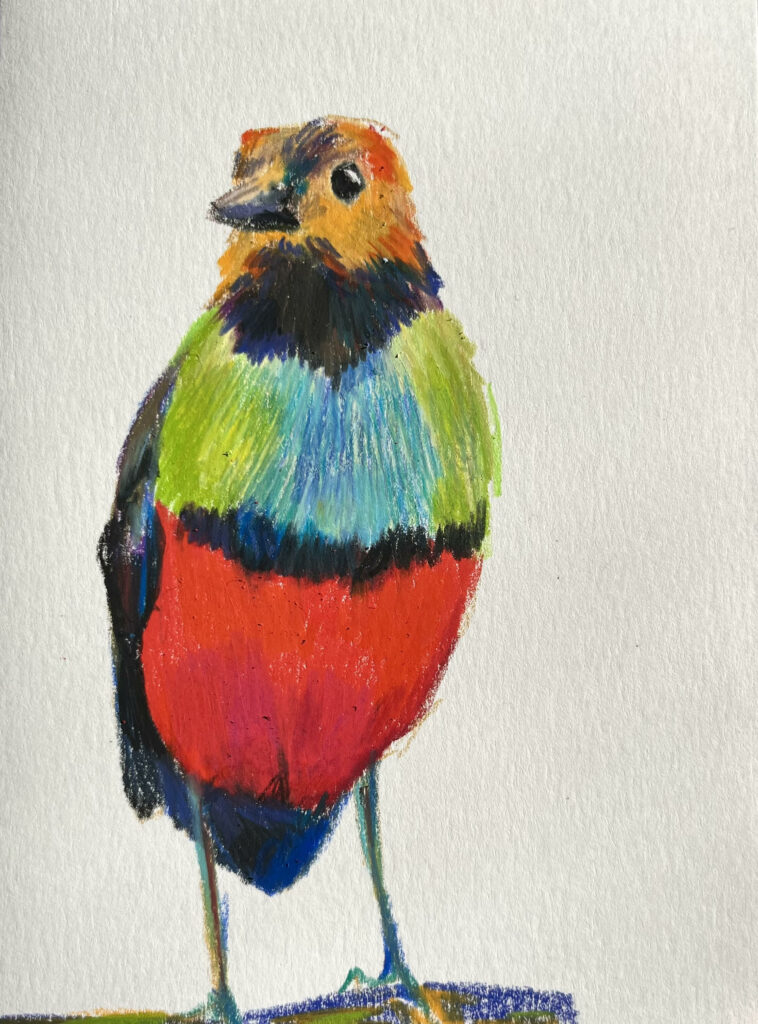
This week I drew a Red-bellied Pitta, a bird found in Asia and some parts of Australia. There are many types of Pitta’s, and most of them have red bellies. They are rarely spotted, and often stick close to the forest floor in dense shrubbery on the hunt for beetles and other insects. They are fairly silent birds, only whistling during mating season. I find they look a bit cheeky.

I chose to use one of my more colourful mediums, the Caran d’Ache Neocolour crayons. These crayons are water soluble, making them suitable for a range of projects. I have used these with young children before, as the process of drawing and then blending with water is often satisfying and adheres to a more process based art making. I didn’t use any water on this piece, as I like the texture from the painting, and as I blended a lot using separate colours, I didn’t want it to become too muddy. This tool is very accessible for students, and the colours are so rich. I was able to buy a set second hand at thrift craft downtown, which is one of my favourite resources as I have been able to try many new things for much cheaper as I was not buying them new. As I became more familiar with the tool, I collected a few extra colours from Opus, they are available to buy individually. I’m glad I chose a brighter subject this week as I feel a bit sluggish at this point in the semester and can use all the help I can get when cheering myself up.

I’m planning on giving this one to my old boss that I have been missing lately, as she became a good friend while I worked for her. I learned a lot of creative problem solving from her and she was a reference for me to get into the program. I have to take a book back to her studio anyways so I thought I’d tuck a card in there too.
Free Inquiry – 5

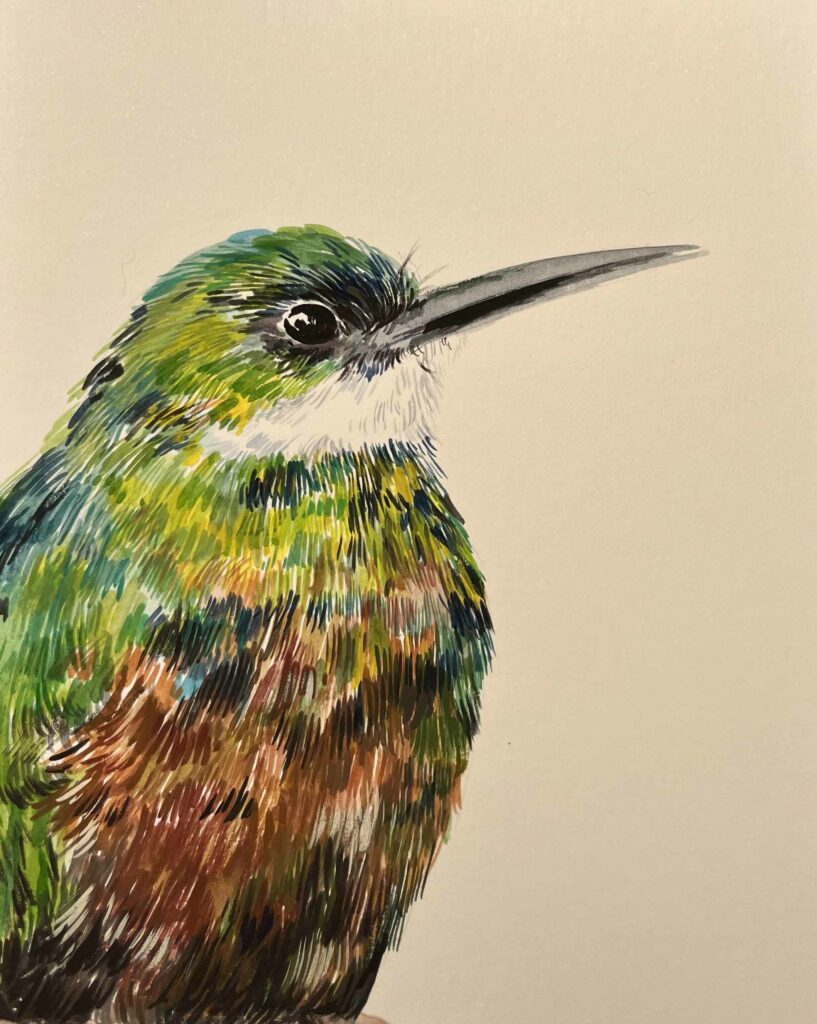
This week I painted a Rufous-tailed Jacamar, a bird I have never heard of before. It resides in wooded tropics, usually near clearings and creeks as it feeds on butterflies, dragonflies, and wasps with its long bill. They make a lovely shriek, and I really appreciate the bird call portion of many birding websites.

For the medium I chose holbein acrylic gouache. I did a big project with gouache in the summer with different subject matter, and I found this a bit more challenging working smaller and with something involving less foliage. I am feeling a bit burnt out in general with getting work done, and I think if I try something totally new next week I might have more success. The acrylic gouache is fun to collect, as it comes in many colours. I’d love to use a wet palette as I find the paint dries very quickly and I end up wasting a lot which is unfortunate. I also have had a bottle of medium to mix with it as the colours are so vivid and it stretches the paint further (nice as it is pretty expensive given the size of the tubes). Ideally, I enjoy using watercolour first and then overlaying the gouache afterwards as I find it a bit more vibrant and opaque. This isn’t something necessarily found in a classroom but I think it compares pretty closely to acrylic in general which is pretty standard.

I am bringing this to a party I am attending at my friend Kai’s house on Friday as he is a gracious host and we are all able to get up to some antics over there. We have traded some art over the years and I am thankful he is in my life. I may add a funny little text bubble on the front as well.

Weekly Reflection – 6

https://unsplash.com/photos/cckf4TsHAuw?utm_content=creditShareLink&utm_medium=referral&utm_source=unsplash

Virtual learning as a whole has been beneficial in considering who is able to learn traditionally in a school setting and who might not be. There are many factors to consider when we think of who might be excluded from an average university experience, and how we can adapt classes and courses to be more inclusive and accessible for all. While I often missed the connection in class during the lock-down/quarantine, I felt a sense of ease when it came to school as suddenly I was able to roll out of bed and join in, skipping the commute. Certain courses I felt it was necessary to be in class for, as I needed access to resources on campus to ensure I was getting my moneys worth (film photography wasn’t the same with no access to the dark room and needing to pay for London Drugs to process my film). I think at the very least during a lecture based course that it should be easy to access voice recordings from the classes if one misses due to work, sickness, or mental health. Many of my instructors who have taken the time to accommodate this need said it has been no big deal, and is fairly simple to continue doing.

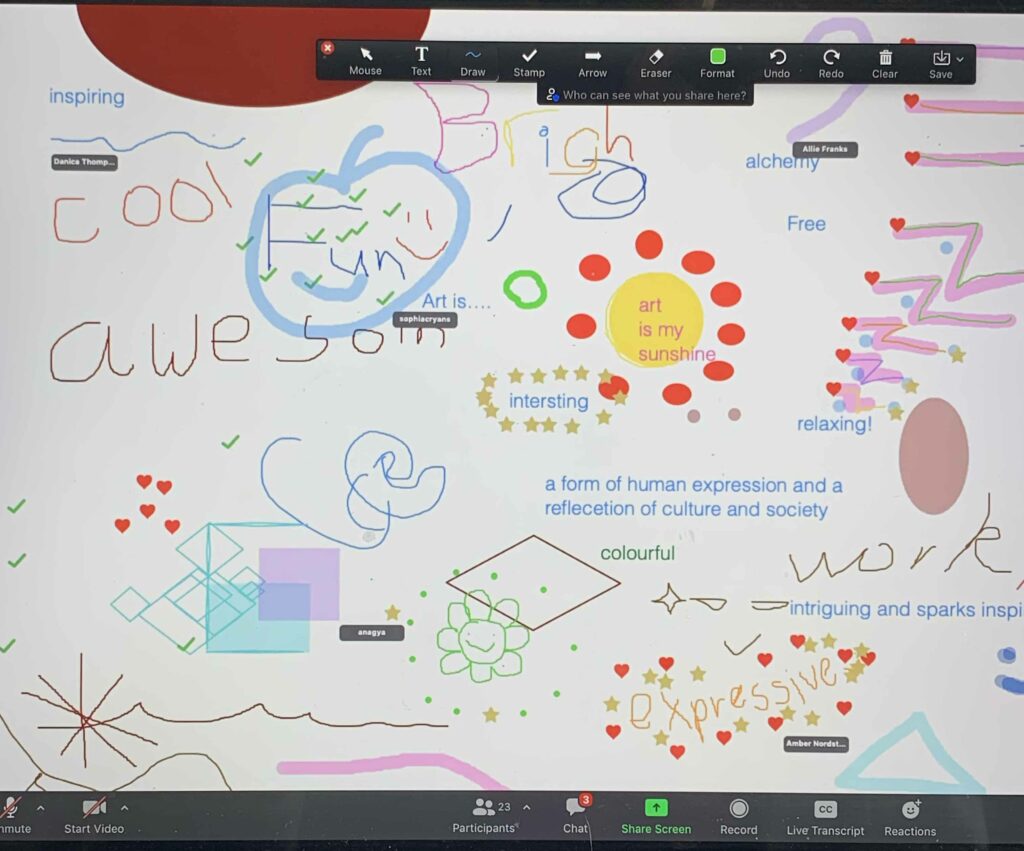
I struggled to care about my painting courses (3 hours once per week) when they were online. It was an uncomfortably long time to spend staring at a screen, and lacked a lot when it came to critiques of our artwork. On the other hand, I was able to attend more artist talks that took place during the evening due to the zoom component, as I found I wasn’t always up for leaving my house at that time after a full day of school/work. I think there is a lot of flexibility required when it comes to teaching and learning, and it is best to be able to incorporate these practices as we want to meet our students where they are at, and ensure they have resources available even if unable to attend consistently for any reason. As far as resources go, I saw the whiteboard function on Zoom used often in Art Education, and we spent time researching the beautifully archived pieces available online through many galleries. It may be a bit dry to go through as a class, but there is so much to explore, I often take inspiration from the Tate site. Attached is a photo of a whiteboard from art ed 103 I took during Covid. I loved the interactivity and obviously liked it enough to take a photo.

Free Inquiry – 4

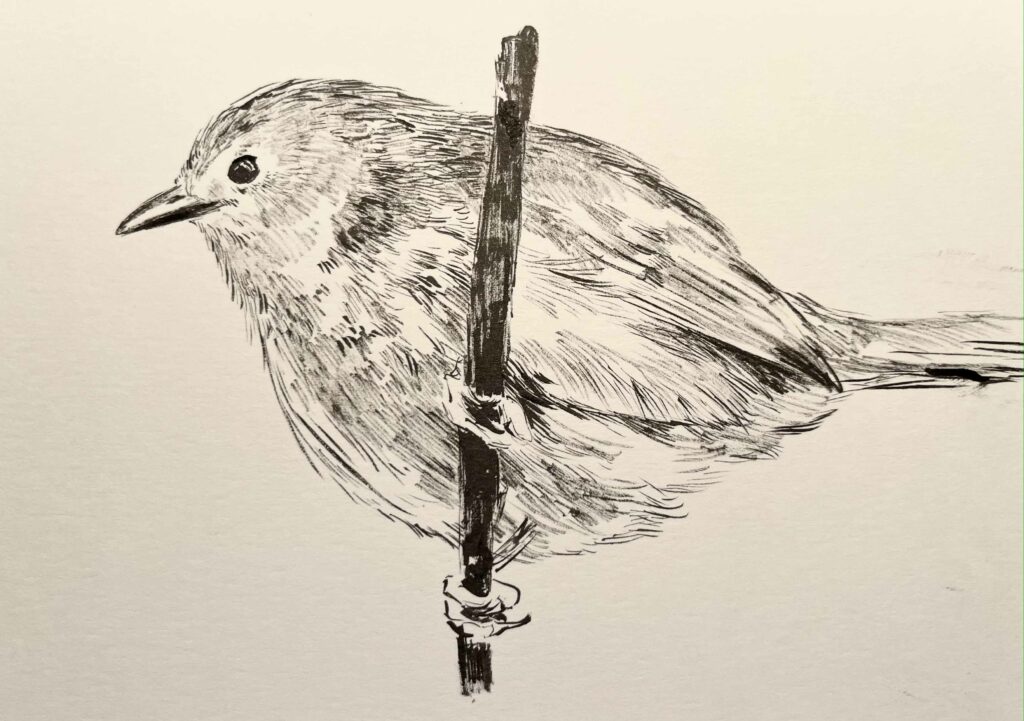
This week I chose the Graceful Prinia, a small warbler found in Africa and Asia. I picked a neutral coloured bird as I wanted to try out ink again, but found it to be a bit more challenging than I remember. I did a large piece of a bat a few years ago with ink but I may have used different brushes for that one. I did a lot of exploration with ink and brush with younger children a few months ago and it is so messy but worth it. The different brush techniques and characters they come up with are fantastic and it leads to some interesting problem solving given its permanence. One thing to note is cleaning the brushes has to be done thoroughly as the ink works its way into the bristle within the brush handle. Ink can be so dynamic and intense, which can lead to some confidently made art. You have to be able to roll with mistakes, as it is bound to happen in the form of a dip or smudge.

The Graceful Prinia lives in dense grassland and shrubbery, as it feeds on insects. They make beautifully woven nests that they can use long term due to having no need to migrate. They have a stable population, which is always a welcome fact. This card I am sending to my grandparents, as they often send me cards and my Grandma had surgery this past week. Both of them are very artistic people, and connecting to the gratitude portion of the wholehearted teacher session in 352, I would absolutely not be where I am without their encouragement in the arts and I am so thankful to have a family who supports what I am passionate about and did not think twice about wether art school was a smart choice or not. I think this week I’d like to continue working with ink, and it was also something brought up in my art instruction class – working with ink and unconventional tools for more exploration.

Weekly Reflection – 5

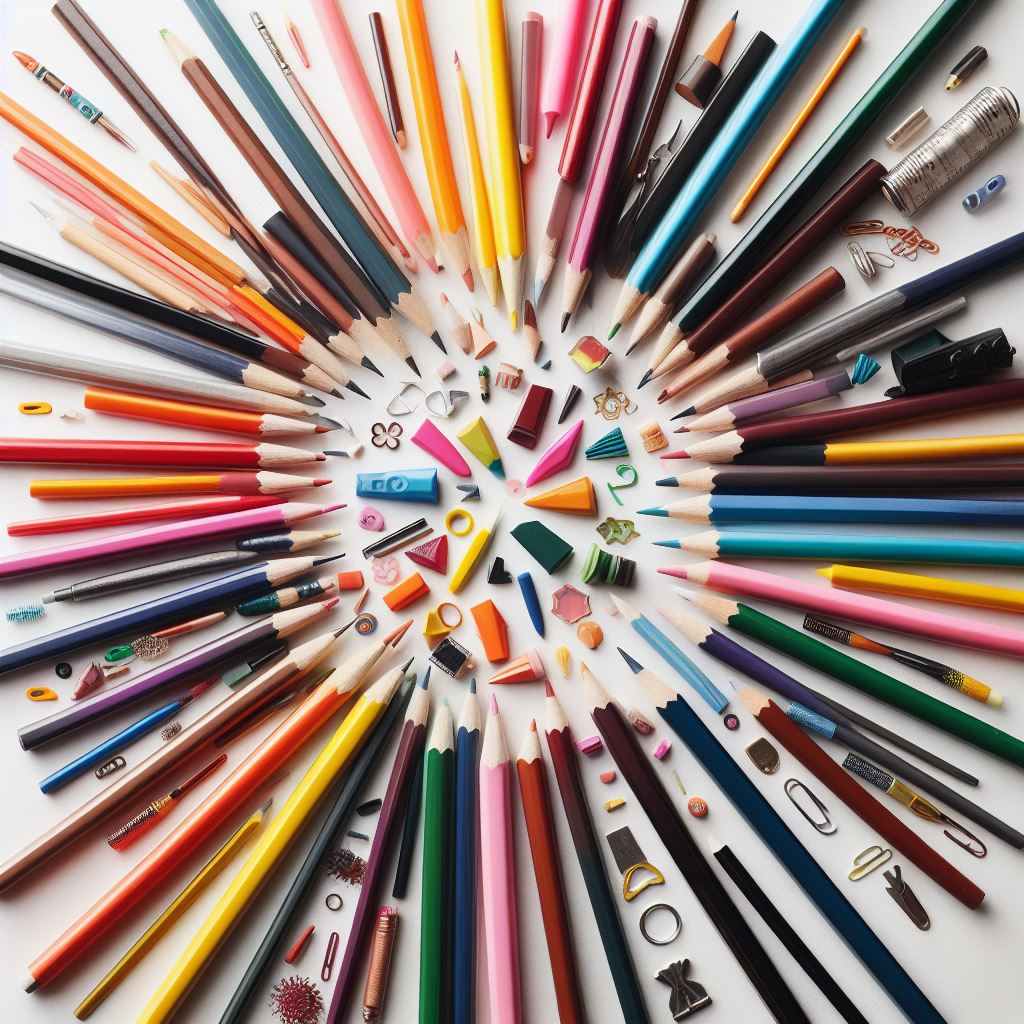
This is an image I had Microsoft bing designer make for me based on the prompt “pencil crayons spread out on a white background” and I find it interesting how many extra bits and pieces the generator added in. Most of them are somewhat stationary/office supplies but a bit distorted and unrecognizable. I haven’t used AI generators much, besides for some goofy things with friends. I don’t know if I like it much, and I read a quote recently that was in regards to AI written content but an illustrator shared it but have now lost the exact post… but it captures the idea of why should I spend time reading something/looking at something no one had the passion to actually create. I think that stuck with me, and I know there are some other issues surrounding how art is sourced from online as far as AI goes and many creators are finding it frustrating. As I will be teaching art, I would like to get a better handle on my photoshop skills, and will likely be incorporating many visuals within my courses. Even if it isn’t as polished, I would often rather see someone’s genuine attempt at creating something over what could be created at the press of a button and a prompt. I do find the Microsoft designer is a bit more polished and more focused on font/design elements more appropriate for a presentation, which I think is helpful.

Free Inquiry – 3

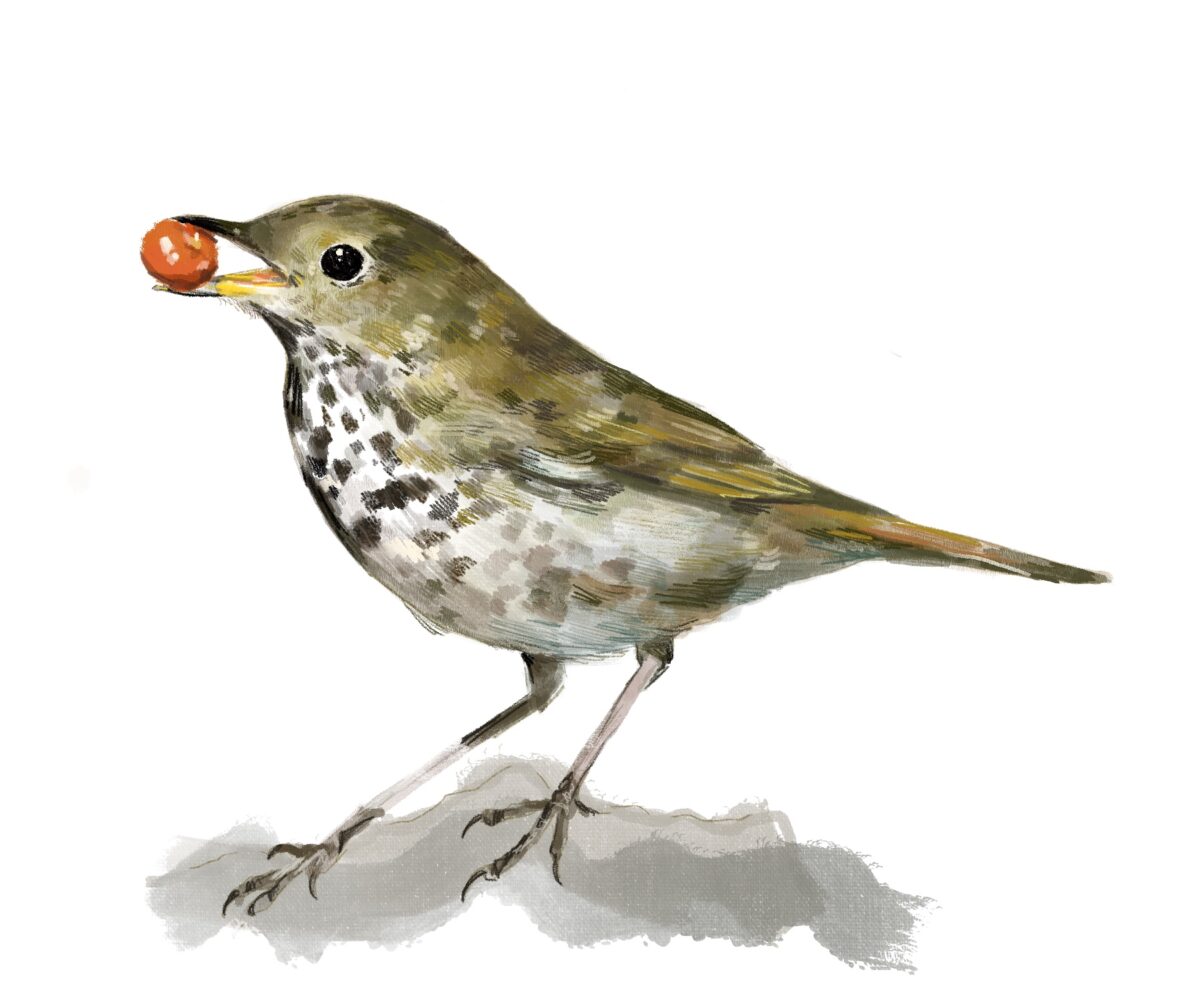
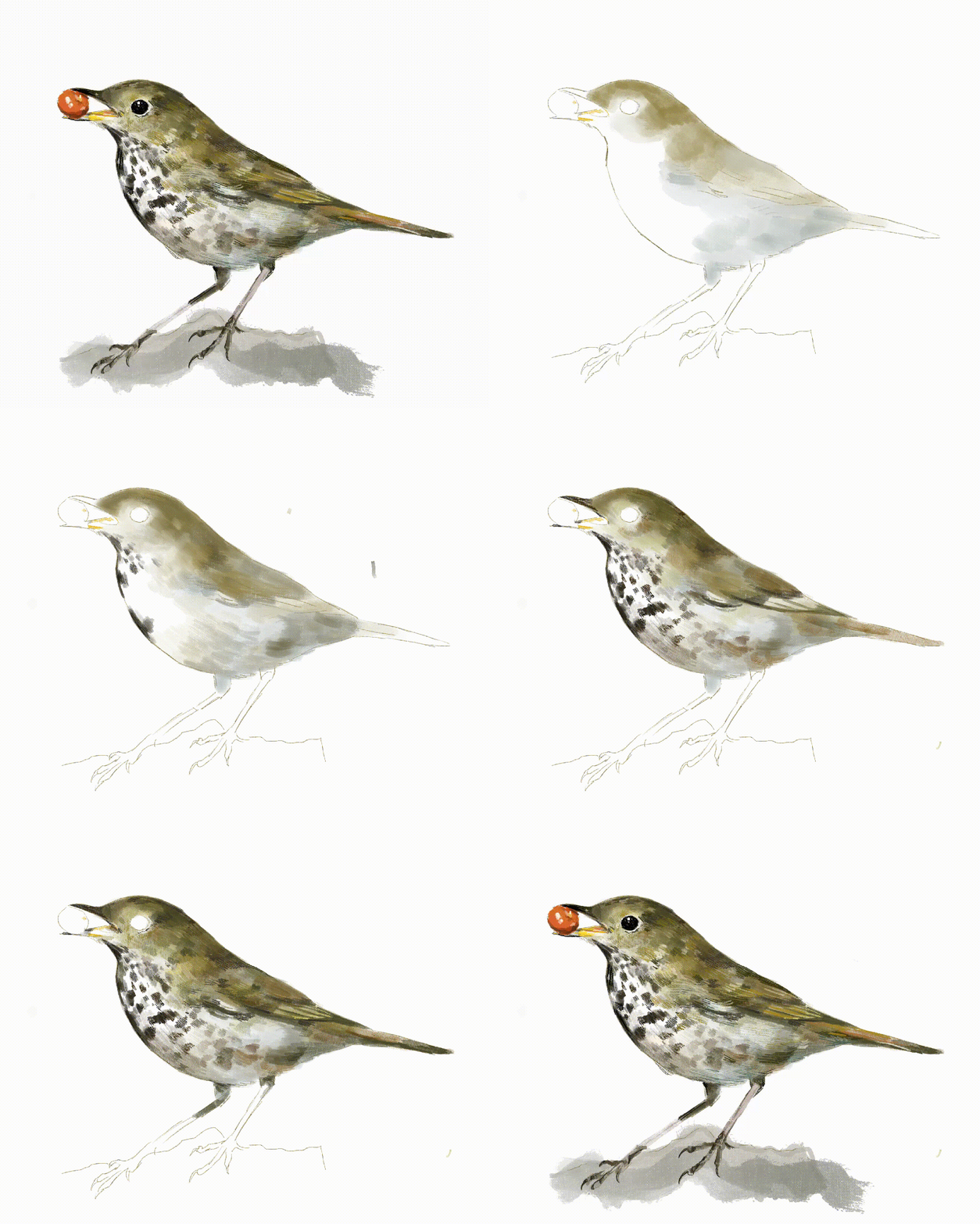
Week three features the Hermit Thrush. It is found all over North America, in Boreal forest and open woodland. What I didn’t know, was that it is a ground dweller, and constructs its nest on the ground. Both the male and female look similar, with dark olive-y brown and spotted underparts.

I decided this week I wanted to try working digitally, as I liked the idea of including a screen capture of how I paint. I can see I don’t stay and finish one spot at a time, but rather move around with similar colours which I believe creates unity in the piece. I find digital work both easier and more difficult, as you can use references more easily, but lose the pencil and paper feeling I love so much. I have a “paper” screen protector that I should likely replace at this point, as it has been well loved. Procreate is one of my favourite tools, as it is a one time purchase, unlike so many subscription based services (photoshop for example). I find it is much easier to use than adobe software in general, as I have a strong dislike of the pen tool in illustrator. There was a lot of talk in my fine arts program about the validity of digital art compared to traditional medias, and I don’t think it is any less valid, as long as it is shown in a professional way with considerations to tech or printing. Price of an ipad aside, I find this is becoming a more popular medium amongst teens and there have been more classes offered featuring digital arts in high schools. It can open a lot of doors for students, and if feasibly possible I find it is a fun tool to bring travelling instead of carrying paper/paints/pens around.

Weekly Reflection – 4

Screencastify/Screen Recording

I have seen this technology in action, successfully, at Royal Bay in the media courses. Instead of taking the time to record it outside of lesson time, the teacher simply records during the class, and uploads it to the google classroom after the students return to their computers. It isn’t as pretty as it could be, but it functions all the same as the students have access to it anytime to review exactly what was taught in class. I had some issues with converting the recording to an mp4 file, but I know what to do for next time. I may have missed it on the plug-in, but I was hoping to see graphics that could be added in such as arrows and such. I’ll likely practice this a bit going forward as my first attempt was a bit clunky, and I think it will be very useful when I am teaching. I would also like to set up a camera on a tripod and create similar videos but with tactile painting and drawing techniques, but also then use the plug-in to make it more interactive. The photoshop demos shared at Royal Bay don’t often feature an interactive element, but are an important tool regardless as photoshop has such a wide scope of possibility and it can be an overwhelming tool to learn as so many functions seem to hide. It is something that must be practiced rigorously (in my experience).

The flipped classroom model really spoke to me, as this would have been something helpful while I was in school. I’d like to use this model as well as students can be responsible for their learning and we can get right into it during class time. I think as long as there are reminders for students (I struggle with remembering small tasks, like watching a quick video…) before the lessons then it will be a great tool. I’d love it if the students came to class with a question, maybe something I can help answer or a classmate can assist them as well.

Link to my demo – I wasn’t entirely sure how to save the interactive video to my computer, and the summary piece confused me a little bit as it seemed unavoidable.

Weekly reflection – 3

Multimedia Learning

I am intrigued by the concept of constructive alignment, and how it creates a meaningful learning experience. I can see how this aligns with art as my teachable, and how the topics and concepts presented to students will be engaging as it connects them to their communities and to their unique identities. While I think some of the YouTube video went without saying or connected to concepts we have already gone over, I believe it is important to give students control over the pace of their learning experience, especially when delivering a lot of content at once. Even while watching the video at home, I paused and would watch certain sections again if I needed an extra explanation or moment to jot something down. The Redundancy Principle was important to note as well, and I want to ensure as a teacher I am not overloading a lesson with too many examples but am selective with what content is shown in class while providing extra material afterward if needed, which again gives students more control over their own learning as not everyone will always come to class ready to learn (which is okay).

I am eager to try out Canva, as I have heard nothing but positive things about it so far.

Free Inquiry – 2

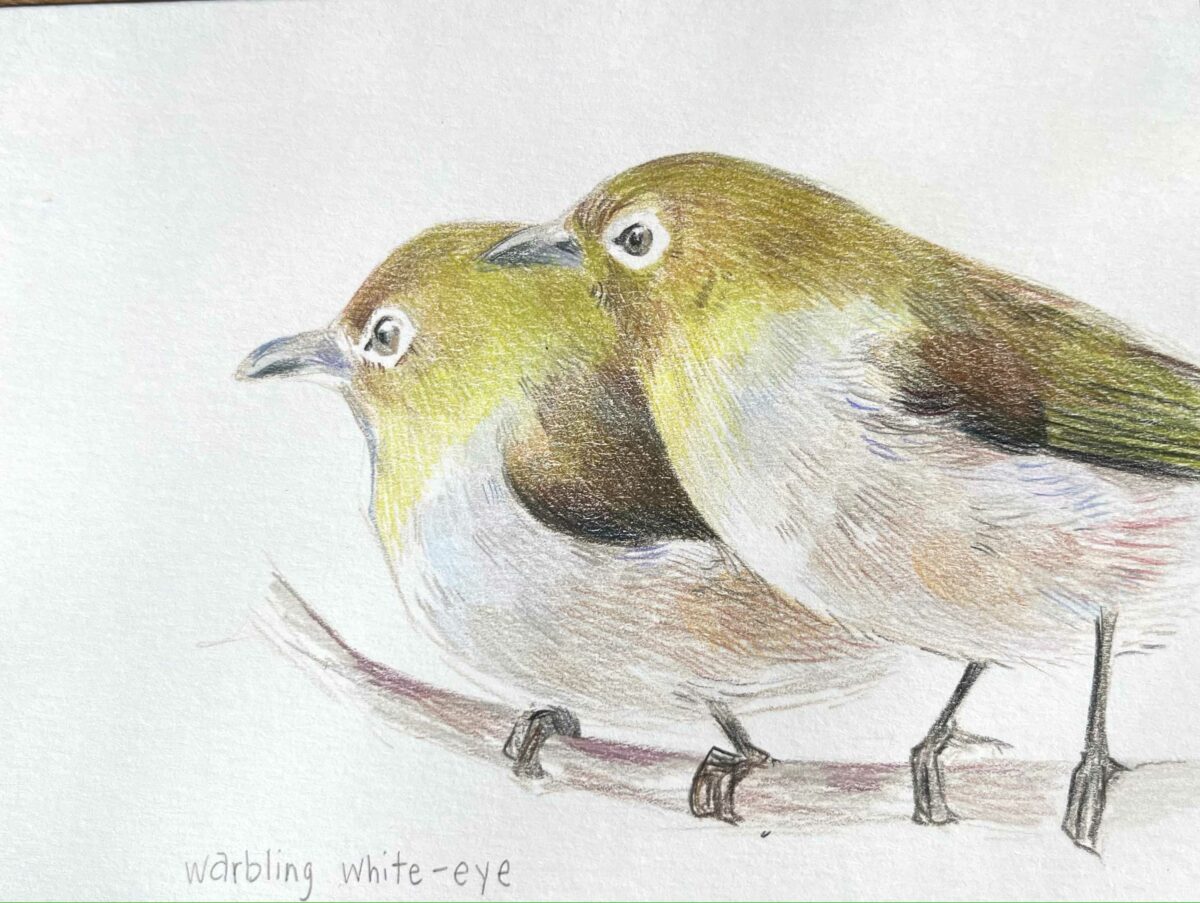
Back again this week with a pencil crayon drawing of two Warbling White-eyes, on the standard mixed media card.

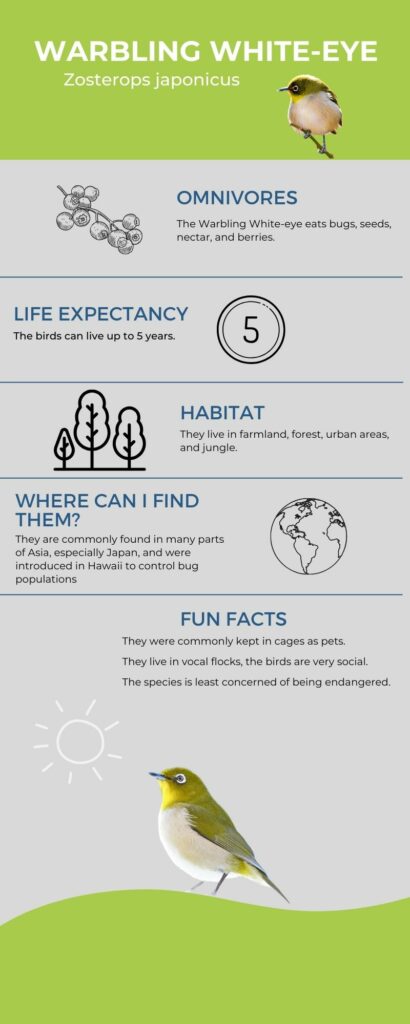
Considering the fact I use pencil crayons rather often, I chose to make the composition slightly more difficult and used a reference with two birds. The birds in question are Warbling White-eyes, also known as Japanese White-eyes. I’ve enjoyed both weeks now listening to the bird call, and my cat seems to enjoy it too. It is native to Asia and travels in vocal flocks through forests, urban areas, and farmland. They are fairly common birds, not endangered in the slightest, and were introduced to control bug populations in Hawaii in the 1920s. They are omnivorous and love fruit, are very social, and can live to be 5 years old.

Prismacolours! My preferred type of pencil crayon. My favourite colour is green, and I love being able to find references and animals/birds where I get to employ the best Prismacolor of all time, lime peel. They blend beautifully, although I didn’t find myself blending at all, but layering colours instead. They can be applied very softly and I find them much easier to use than something like a crayola. I was happy to see that they have full packs of them to use at the school I have been at for my link to practice, as it is nice to have access to higher-quality supplies at the high school level. While these pencils aren’t necessarily cheap, I like that you can buy one at a time, as I go through them at different rates and you don’t have to sink too much into it initially while trying them out. Overall, I find their texture satisfying, and I love the ease of bringing pencil crayons out into the world with me. They often come camping or travelling as it isn’t such a messy endeavour.

This card is for my family friend Hallie, who has just started University in Vancouver at Emily Carr. I’d like to send her something as this is her first time living away from home and I am thinking of her often as I’m excited for her. I enjoyed receiving mail when I first moved out from her and her younger sister, and I’m sure it can’t hurt to send her some in return give or take seven years later.

Photo by Kawasaki Toshihiro on Unsplash

Photo by Kawasaki Toshihiro on Unsplash

Free Inquiry – 1

Overview –

My Inquiry Project will focus on art, as each week I will explore a different medium while working with birds as subject matter. I was recently given a massive book on birds by an older gentleman who frequents my workplace. Over the years we have chatted quite a bit and given each other many artistic-related gifts. I will be using multi-media cards as my base for the artwork, as I will give them away as I go. I’d like to try watercolour and acrylic gouache, calligraphy pen, lino cut printing, oil paint, pastels, markers, neocolour crayons, and pencil crayons. If any other mediums catch my eye along the way I’d be happy to switch one out for something more complex or interesting. Along with the painting, I’ll upload some information on the bird I’ve chosen, and the medium selected – challenges or notes for future use. I’ve said on many occasions, although jokingly, that the best part of being an artist is making personal birthday/holiday cards for my loved ones. It’ll be nice to think of someone as I paint, and while I don’t have any reason to give anyone anything I’m sure it will be somewhat fun to receive.

Week One –

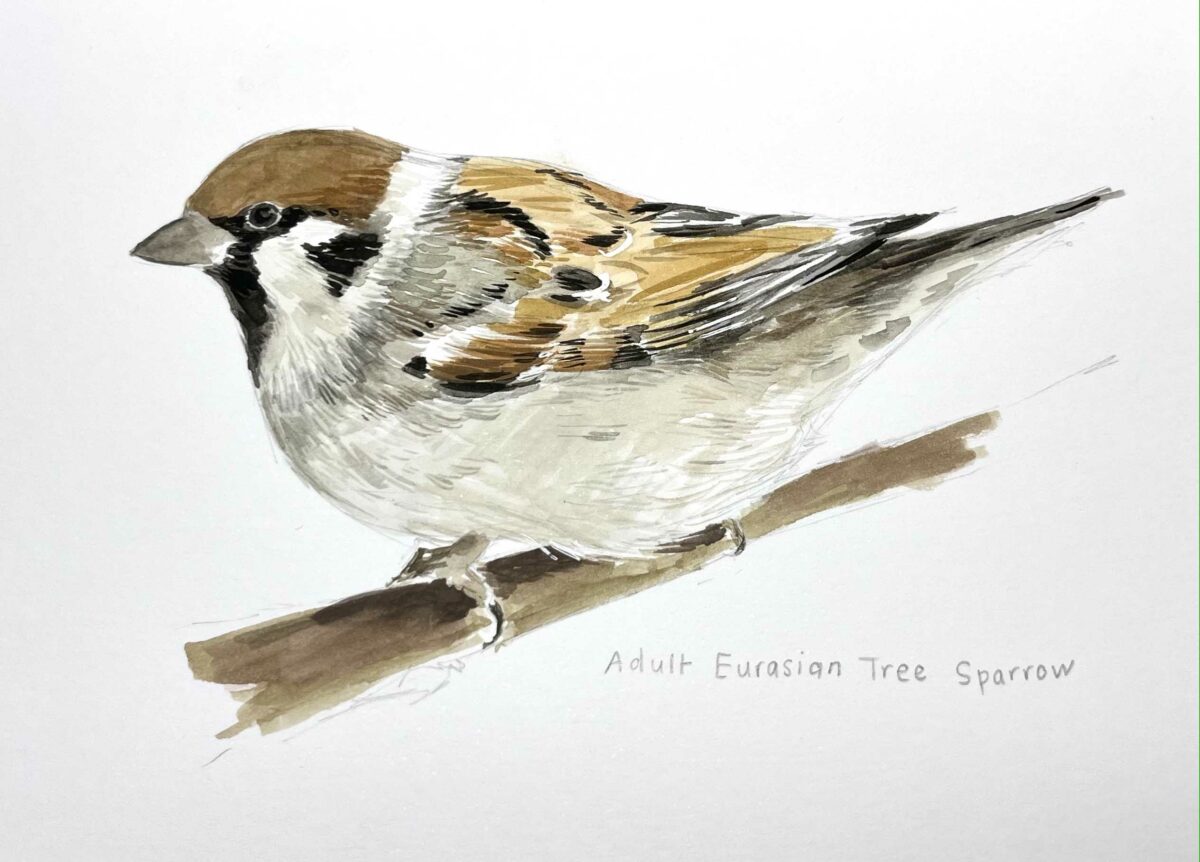
This week I worked in watercolour gouache, focusing on the Eurasian Tree Sparrow, found commonly in Southeast Asia but has been introduced in the USA and Europe. Its habitat is farmland and woodland, as it enjoys a scattered treeline. It reminds me of a brown chickadee, and it is roughly the same size, if not a bit bigger. They favour nesting in buildings, cliff faces, and holes in trees.

The watercolour gouache I used is the Winsor and Newton variety, which I struggled with slightly due to not having a full set (it is hard to get my hands on the individual tubes, Michaels stopped selling them). I do like getting by with less colour-wise sometimes, as it forces me to rely on mixing more efficiently than just using what is available. I’d love an olive green though and I think it would have helped quite a bit. I like these paints as they are a bit more opaque than regular watercolour, but layer similarly. Once dry, they become a bit chalky, and they worked well with the mixed media paper. The first card I made is for Cal, as he provided the inspiration for the project, and I am probably due to give him something in return. I imagine he would also like to hear about the project.

This was a fun bird to start with, I am more familiar with local birds and look forward to expanding my knowledge on more birds from other countries. While choosing this project, I wanted to ensure it was something I could comfortably complete each week and use for future reference. I’d like to use some of the materials I already own but invest in a few things I don’t.